Questions & answers
Dumpster Rental FAQ — Cape Coral, FL
Everything we get asked on the phone, written down. If your question isn't here, ring us and we'll answer it properly.
- Same-day & next-day delivery
- Flat-rate, all-in pricing
- Driveway protection included
Booking and delivery
How quickly can you get a dumpster delivered in Cape Coral?
If you call before about noon on a weekday we can usually deliver the same afternoon, and next-morning is standard the rest of the time. Atlantic hurricane season, June through November, is our busiest and least predictable stretch in Lee County — Southwest Florida sits in an active Gulf Coast hurricane corridor, and both pre-storm yard clearing and post-storm cleanup calls can spike fast. Outside of storm season, roughly 355 days of sun a year means there's no real seasonal slowdown here the way colder markets have, and Cape Coral's ongoing new-construction boom keeps our schedule steady year-round. If your project has a fixed start date it's worth booking a few days ahead. Storm cleanup calls get moved to the front of the queue where we can.
What does your flat rate actually include?
Delivery, a standard seven-day rental, pickup, a stated weight allowance in tons, disposal at a permitted facility, and state and local taxes. There's nothing hidden underneath it. The only things that would change your number are keeping the container past the rental period, going over the weight allowance, needing it relocated on site, or putting banned material in it.
Do I have to be home for delivery or pickup?
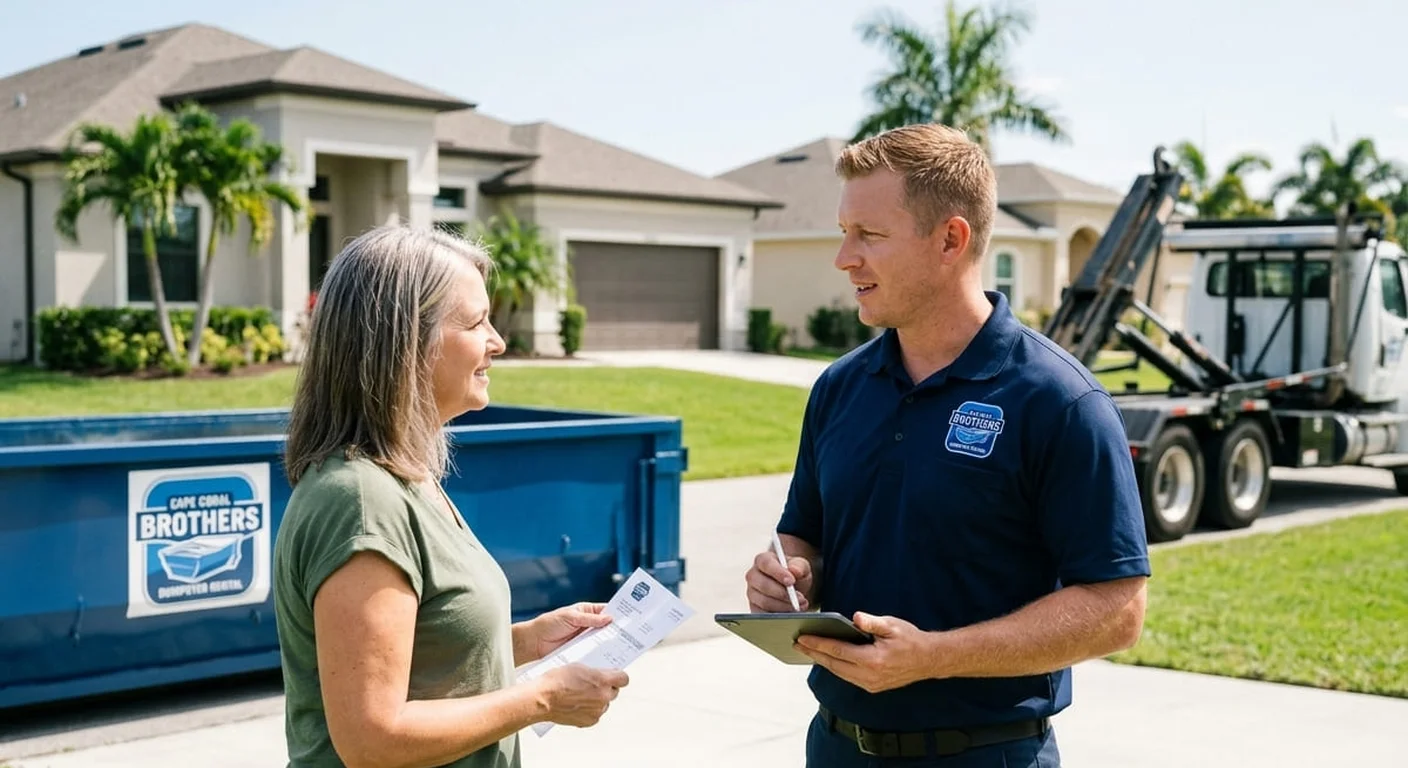
No. Most of our deliveries and pickups happen while nobody is standing in the driveway. Just tell us exactly where you want the container, keep the spot clear of vehicles, and our driver will place it, protect the surface, and text you a photo when it's down. Pickup works the same way — call when you're done and we'll send a driver out.
Can I get a container delivered when I am not home?
Yes, and it's very common. You don't need to be present for delivery or pickup — just tell us exactly where you want it, a photo texted to us helps enormously, and make sure the spot is clear. Our driver will place it, lay the protection boards and text you a photo when it's down.
Sizes, weight and loading
What if I order the wrong size?
Call us. If it's too small we can bring a second container or swap it, and if you genuinely haven't touched it, it can usually be exchanged for a different size the same or next day. It's far cheaper to make one call than to overfill a container — an overloaded box legally cannot be transported and will have to be leveled before it can be lifted.
How much space do I need for the container itself?
Allow roughly 10 feet of width and the container length plus about 15 feet of clearance behind it so a truck can set it and pick it up. A 10 yard needs about 25–30 feet of total run, a 30 or 40 yard closer to 60. Vertical clearance of around 23 feet is needed for the hoist — mind overhead service drops on the older streets around Cape Coral and any low-hanging canopy near a canal lot.
What happens if I go over the weight allowance?
The overage is charged per ton at a rate you're told up front, based on the scale ticket from the disposal facility. You get the actual ticket. Most residential customers never see one — it typically comes up on heavy material like stucco, tile, block, concrete or wet fill dirt that runs heavier than expected.
Can I fill it above the top rail?
No. The load has to sit level with the top rail so it can be tarped and legally transported on Florida roads. If it's heaped, we can't take it and you'll need to level it before pickup. When you're loading, keep the bulky items flat and fill the voids rather than building a pile at one end.
Which size is most popular in Cape Coral?
The 20 yard, by a wide margin. It's the sweet spot for whole-home cleanouts, mid-size remodels and roofing jobs, and its walls are low enough that you can throw things over the side rather than walking everything through the house. The 15 yard is the runner-up for garage clearouts and storm-debris cleanup.
Pricing and payment
How is a dumpster rental priced?
By container size, the weight allowance included, the rental period and how far we have to drive. We quote all of that as a single flat rate that already includes delivery, pickup, disposal and tax. The full breakdown is in our pricing guide.
Are there any hidden fees?
No. There are four things that can change your invoice and we tell you all four up front: exceeding the stated weight allowance, keeping the container past the rental period, asking to have it relocated on site, and putting banned material in it that has to be sorted out. Nothing else.
How do I pay, and when?
We accept major credit and debit cards, and payment is collected when you book to confirm your booking and lock in the rate quoted. Established contractors and commercial accounts can be invoiced on terms. If there's a weight overage or extra rental days, that's billed afterwards against the actual scale ticket, which you'll be shown.
What is a dry run fee?
It's what we charge when a truck arrives and can't deliver or collect — a car blocking the spot, a locked gate, an overloaded container heaped above the rail, or an inaccessible driveway. We'd much rather avoid it than see you charged for it, which is why we call ahead. A quick text if plans change usually prevents it entirely.
What can and cannot go in
What can't I put in the dumpster?
Florida restricts a number of materials from ordinary landfill disposal — paint, solvents and oils, tires, batteries, hazardous chemicals, propane tanks and gas cylinders, and medical waste among them. Call us and we'll tell you exactly where each of those should go instead, or point you to Florida Department of Environmental Protection (FDEP) or Lee County Solid Waste Division for the full rules.
What can go in the dumpster?
Wood, drywall, tile, flooring, furniture, general household junk, yard debris and clippings, roofing shingles or tile and small appliances are all fine in a standard mixed load. Breaking down bulky items before they go in makes a real difference to how much you fit.
What about appliances?
Small appliances are fine in the dumpster. Anything containing refrigerant, including refrigerators, freezers and air conditioners, needs the refrigerant professionally recovered before it can go to a landfill. Set those aside and we'll point you to the right place.
Can I put paint in the dumpster?
Not wet or liquid paint, solvents or oils — those, along with tires, batteries, hazardous chemicals, propane tanks, gas cylinders and medical waste, are on the prohibited list. Latex paint can go in once it's fully dried out solid; wet paint of any kind needs to go to a household hazardous waste collection instead.
Permits, placement and property
Do I need a permit for a dumpster in Cape Coral?
Not if it sits on your own driveway or private property, which covers the large majority of our residential drops — no permit is required anywhere in Lee County for a container on private land. If the container has to sit on a public street instead, City of Cape Coral, FL is the office to confirm a temporary placement permit with for an address inside Cape Coral. If your job is in one of the other communities we serve, check with that town's own office if it has one, or with Lee County, FL for the unincorporated parts of the county, before you book.
Can you deliver to a canal-front or waterfront lot?
Regularly. Cape Coral has more than 400 miles of navigable canals — more than any other city on Earth — so a large share of what we deliver every week sits on a canal-front street. We work around narrow street width, seawall and dock access, and any container rules a canal-community HOA has, and we'll ask about all three before your delivery date so the driver isn't guessing when the truck arrives.
Where can the container be placed?
Wherever works for the job — a residential driveway or curbside, a construction or demolition site, or a commercial lot. On private property you won't need a permit anywhere we serve. If it needs to sit on a public street, a temporary placement permit may be required from the local government — City of Cape Coral, FL for addresses in Cape Coral, an incorporated town's own office elsewhere in Lee County, or Lee County, FL for the unincorporated communities we serve. Narrow canal-front streets sometimes come with their own HOA rules worth mentioning when you call; see our permits guide.
What if my driveway is shell, gravel or a freshly poured new-construction lot?
Usually fine if it's well compacted and reasonably level. Loose, freshly graded material, or ground still settling on a brand-new build, is the real problem. Tell us the surface and how recently it was poured or graded when you book and we'll bring extra boards, choose a different approach, or recommend a smaller container that spreads less load.
Recycling and disposal
Do you recycle any of what you collect?
Where it makes sense, yes. Metal, clean concrete and yard debris are recycled through local partners rather than sent to the landfill whenever a load allows it to be separated cleanly. It's one of the reasons we ask you to keep heavy, single-material loads like concrete separate from mixed household debris.
Where does the rest go?
To a permitted disposal facility serving Lee County. We follow Florida Department of Environmental Protection (FDEP) and Lee County Solid Waste Division rules on what can and can't be landfilled, and we'd rather tell you a load needs to go somewhere specific than let it become someone else's problem later.
Our company
Is Cape Coral Brothers actually based in Cape Coral?
Yes. Our yard and office are at 805 NE 8th St, Cape Coral, FL 33909, and that's where our dispatch runs day to day. We're not an out-of-state call center — when you call (239) 341-6424 you reach our own Cape Coral team.
How long have you been in business?
We don't lead with a specific founding date because what matters more is how we operate today: a locally owned Cape Coral family business, based in Cape Coral, with a small team that answers the phone and gets a container on your driveway when we say we will. Ask us about our track record with a specific job type and we'll give you a straight answer.
Are your drivers licensed and insured?
Our fleet and drivers are fully licensed and insured to operate in Florida. We're happy to provide a certificate of insurance for general contractors and property managers before a job starts — just ask when you call. It's a routine request for us, and we can usually turn it around the same day so it doesn't hold up your project schedule.
Do you work with contractors on ongoing jobs?
Constantly. Remodelers, roofers, property managers handling seasonal rental turnover, and builders working through Cape Coral's new-construction and infill boom make up a large share of our week. We can set up standing swap-out arrangements with a consistent driver, priority call windows during hurricane season, and consolidated monthly invoicing. Call and ask for the commercial side, and we'll build a schedule that fits how your crews actually work.
What happens to the material after pickup?
Our driver weighs it, then sorts where the load makes sorting worthwhile — clean wood, scrap metal, cardboard, clean concrete and yard debris get diverted rather than landfilled. Everything else goes to a permitted disposal facility. Materials restricted from ordinary Florida landfill disposal are separated out and routed to the right facility, per Florida Department of Environmental Protection (FDEP) and Lee County Solid Waste Division rules.
Question not answered?
Call (239) 341-6424. We'd rather spend two minutes on the phone than have you guess.
Verified sources
Local & Official Resources
For permits, fees and hours, always confirm directly with the source:
- City of Cape Coral, FL — permits, right-of-way and city services
- Florida Department of Environmental Protection (FDEP) — Florida solid waste and recycling regulation
- Sunshine 811 (call 811 before you dig) — call 811 before any digging or footing work
- Florida Department of Transportation (FDOT) — FDOT road and right-of-way information